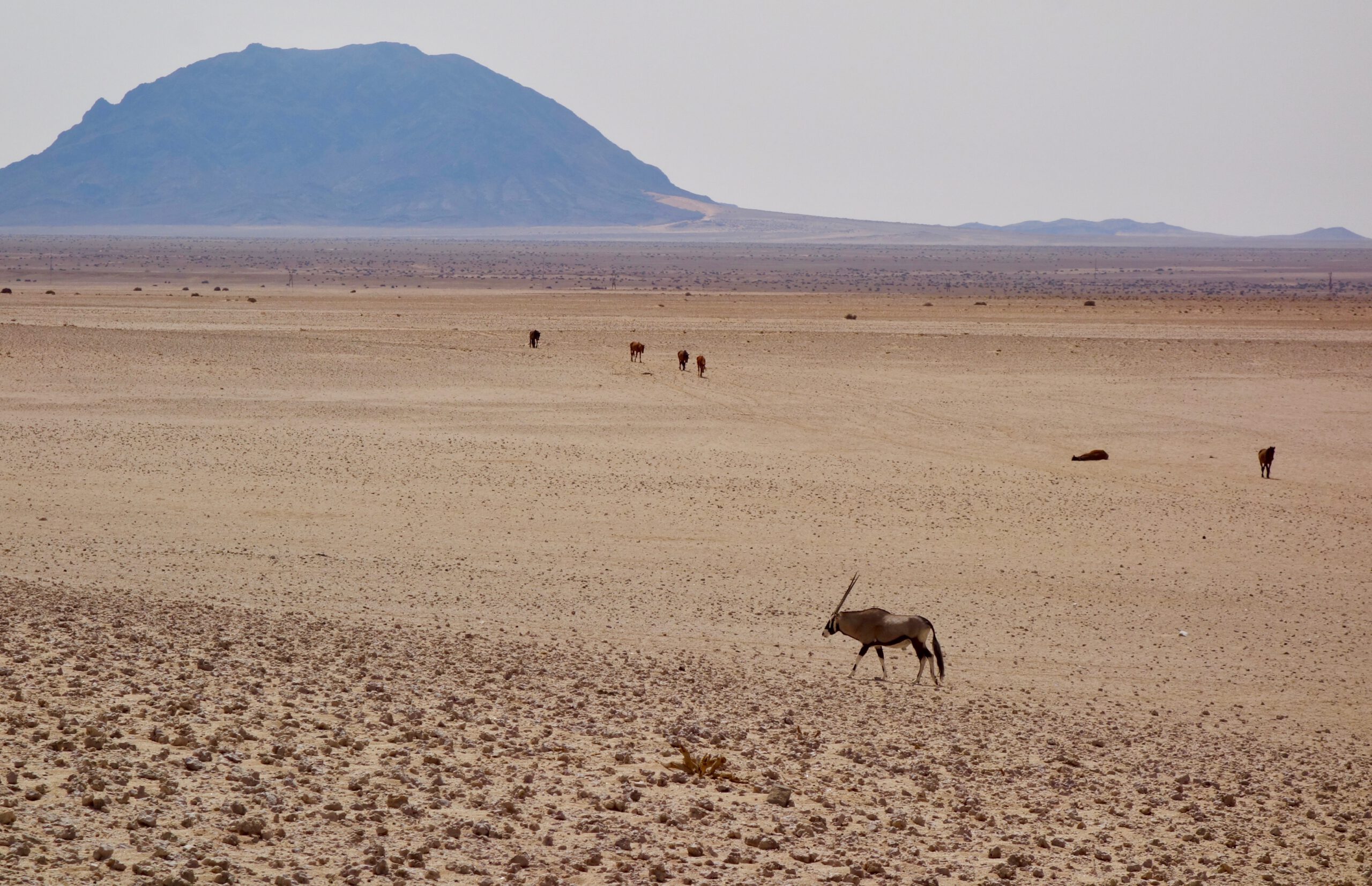
Header image — Photo credit: “Oryx and Wild Horses (37049749623)” by Sonse, CC BY 2.0, Wikimedia Commons
.jpg)
A 500-kilogram horse needs 25 to 30 litres of water a day. In extreme heat, that need can more than double. A camel survives two weeks without a drop. An oryx cools its blood through a heat-exchange system in its skull and only begins to sweat once its core temperature has risen by six degrees.
The horse has none of that.
And yet horses have been living in the Namib Desert for over 110 years.
I first saw this in a documentary on ARTE. In 2023 I was in Namibia — and the image of these animals stayed with me.
Twenty-five kilometres west of Aus lies Garub. A borehole, drilled in 1908 to supply steam locomotives on the railway line. A small observation shelter. And in front of it: horses — in a landscape that was never meant for them.
How they got there is not documented with certainty. The most plausible explanation — also cited in the official Namibian management plan — is this: Emil Kreplin, mayor of Lüderitz, ran a stud farm on the Kubub estate until 1914, just a few kilometres from Garub. When he was interned as a civilian and transported to South Africa, his horses were left behind. In March 1915, an attack on the South African supply post at Garub likely drove additional military horses into the desert.
There are other stories, as well. Whatever exactly happened: a historical event — colonial rule, the First World War, the upheaval of a collapsing administration — threw these animals into an environment they were never built for. And they stayed.
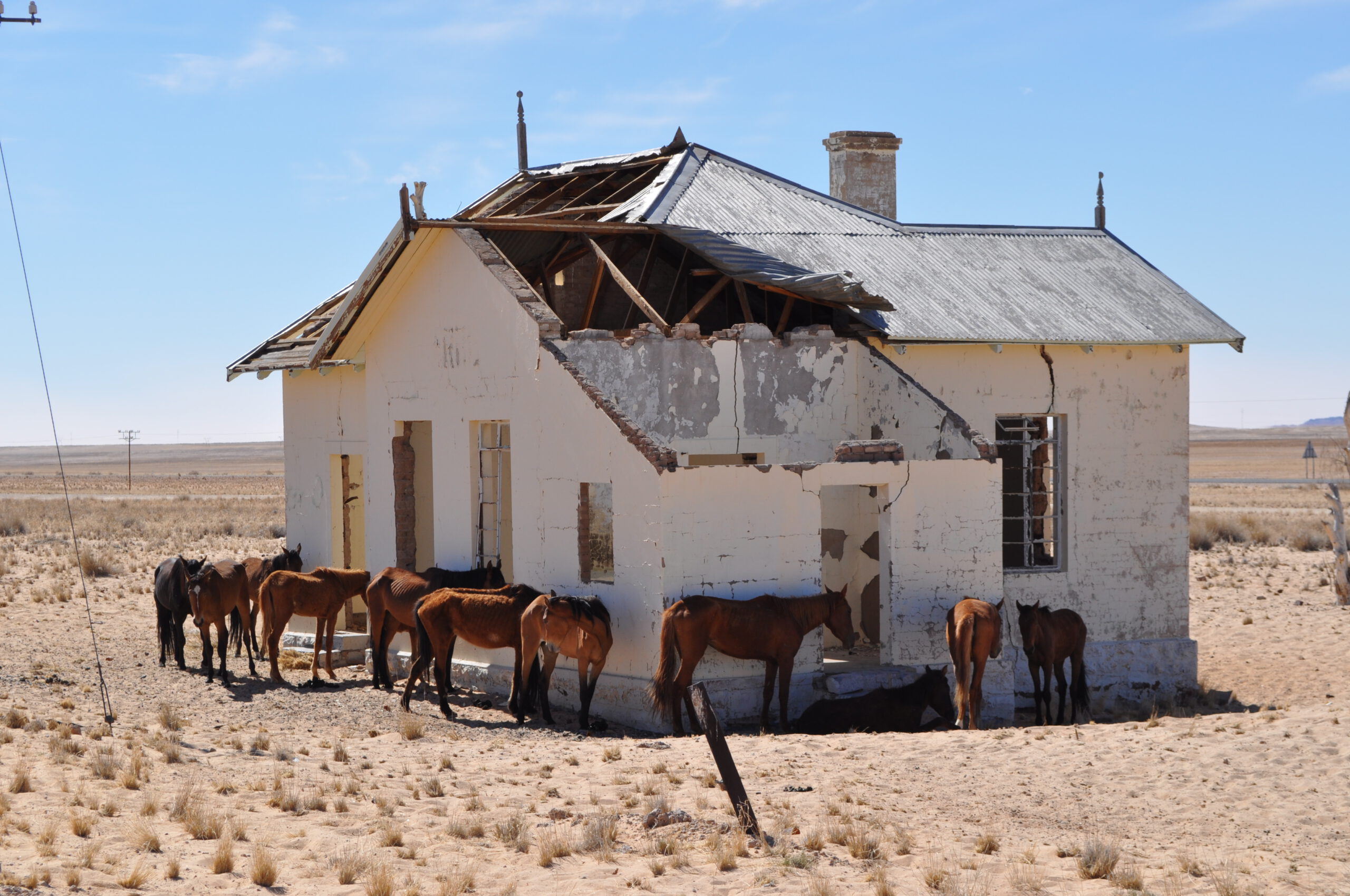
Photo credit: “Desert Horses close to Aus – Namibia” by Raymond June, CC BY 2.0, Wikimedia Commons

Telané Greyling has documented what that looks like in practice across 28 years of field research. The horses drink every two to three days — not daily, as domestic horses do. They sleep roughly four hours a day to keep the distances between grazing ground and waterhole as short as possible. They accept grasses and desert shrubs a domestic horse would refuse.
A physiology study in 1991 put it plainly: the Namib horses are behaviourally adapted — not physiologically transformed. Per unit of body mass, they differ little from an ordinary domestic horse. They survive because they have learned to go thirsty. Not because they have become desert animals.
They remain, and always will be, something that does not belong there.
And they cannot leave.
To the north and east: the wildlife fence of the national park. To the west: the Atlantic coast, where there is no water. The borehole at Garub is the only reliable water source for hundreds of kilometres. Their entire home range: roughly 34 square kilometres. They never stray more than 15 to 20 kilometres from the waterhole.
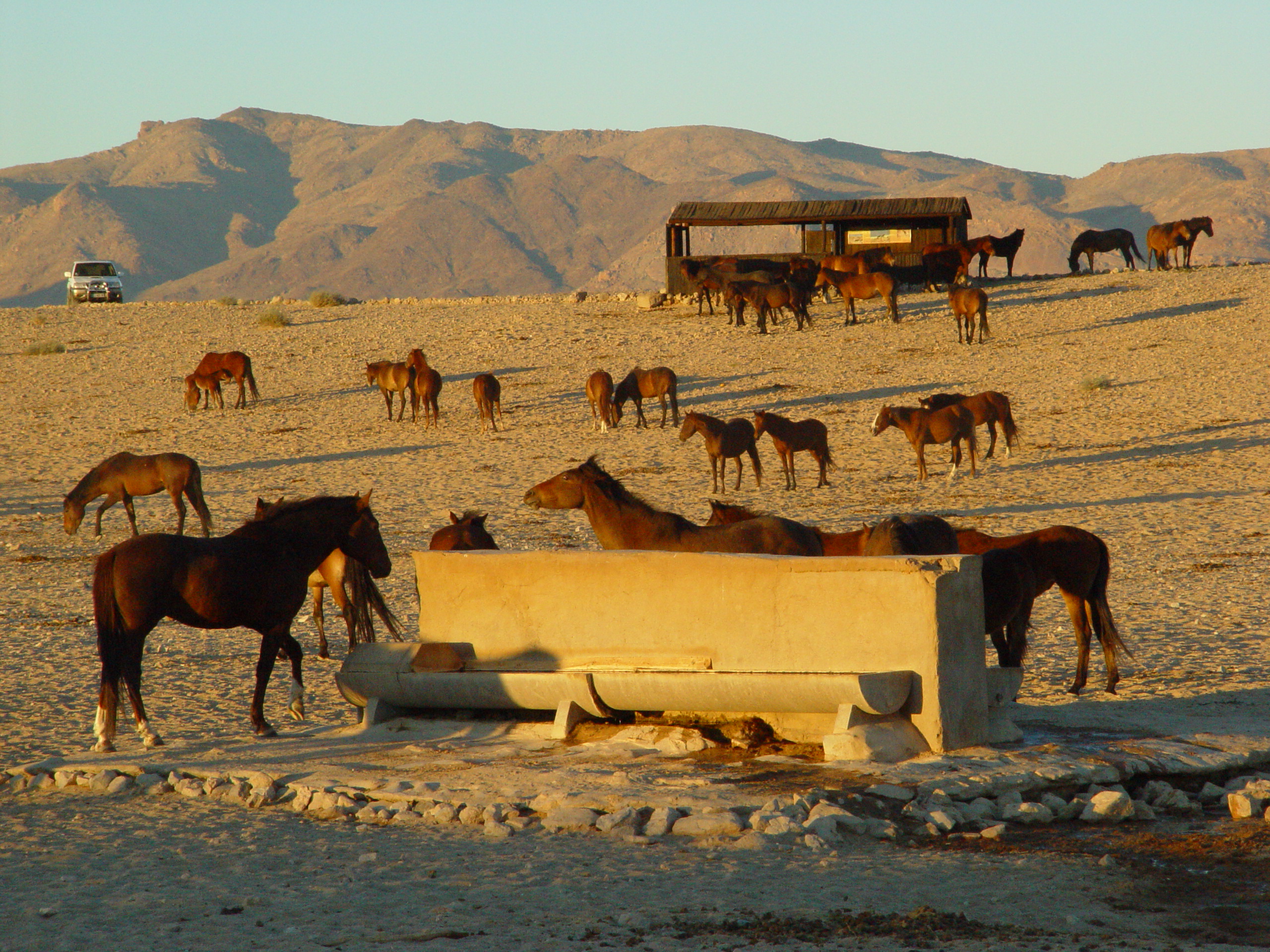
Photo credit: Telané Greyling, CC BY-SA 2.0, Wikimedia Commons

Between 2013 and 2018, not a single foal survived. A spotted hyena clan had established itself in the territory — and the horses had no escape route. In 2013 alone, roughly 100 animals died, half of them foals. The population dropped from 286 to 74. Only targeted intervention and better rainfall years turned the tide: the herd today is estimated at 250 to 300.
The conservation debate around these horses is revealing. The Namibian ministry views them as a non-native species and tends towards letting nature take its course. NGOs and the tourism industry push for active protection. In 2019, the ministry shot three spotted hyenas to protect the horses — a native, protected species, sacrificed for a feral non-native one.
The horses fit no clean category. Not native. Not invasive in the conventional sense. Not domesticated. Not wild in any evolutionary sense. They exist in a gap that the existing terms do not cover.
Now, why do I write about this?
It is not about the feat of survival — that is remarkable, but it is about the situation of living beings who arrive in an environment they were never made for — not through choice, not through evolution. In the case of the horses, it has been through a historical event. My thoughts wander to living beings that are adapting in behaviour but remaining physiologically foreign. Who cannot break out. Who survive — but in a state where adaptation and emergency have become indistinguishable.
I sometimes wonder about us, homo sapiens in the 21st century. I am looking at myself and wonder how much I am equipped as a human being to survive my current environment.
The horses at Garub don’t ask this question. They drink.