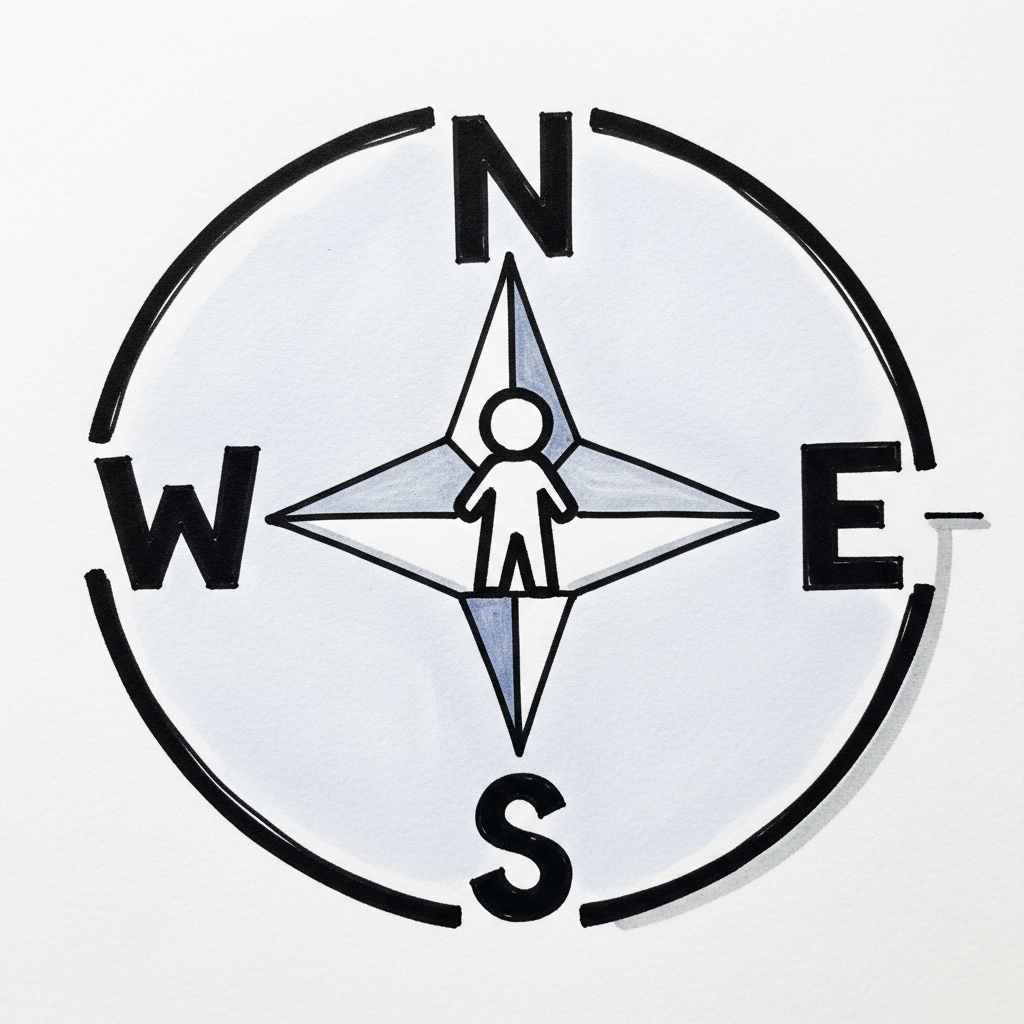
People – Business – Technology – Creativity | Always Learning
That is my guiding principle — and it describes what I have come to believe is true and important across more than 25 years of project experience. Not as a checklist, but as a compass for the daily decisions that arise in complex programs.
People — Technology is made by people
Digital projects rarely fail because of the technology. They fail because of communication, missing ownership, teams that do not actually work.
That is why I place a lot of weight on leadership — and by that I mean something distinct from project management. Project plans, risk logs and budget reports matter. But complex change happens through people who are motivated and understand a shared goal. Making that possible is leadership work, not administrative work.
Change management, in this context, is not a box to tick or a task to delegate. In program management roles I have seen communication — to the project team and to sponsors alike — become one of the most common stumbling blocks. One of the most effective initiatives I drove in that period was a training program for project managers on running steering committees more professionally. The result was measurable: more stakeholder engagement, fewer escalations.
And then there is integrity. Would you want to work for someone who makes decisions based on external pressure rather than values? Neither would I. So I try to lead that way myself: with clear values, commitments I keep — and the willingness to raise difficult things.
Business — Solutions need to create value
Technology for its own sake does not interest me. What interests me is whether a program actually delivers the business value it promised.
That sounds obvious. In practice it is not. Situations arise repeatedly where short-term decisions undermine long-term goals. I have learned to hold that tension — and to make it productive. One example: in a project to decommission an outdated application, there was neither budget nor resources for the sustainable solution. We chose a two-track approach: short-term quick wins with the available means, parallel planning of the complete solution for the next financial year. Not the ideal path — but a pragmatic one that saved costs in the long run and eliminated the technical debt.
Long-term thinking is not a dogma. It is a deliberate trade-off.
Technology — No dogma, but a clear stance
I started with Assembler. Then C++, Java, Python. Waterfall methods with elaborate implementation plans. Later Scrum — first at team level, then rolled out organization-wide. Today I work on AI-driven projects.
What I have learned: the answer is almost never “method A or method B”. It is: “it depends.” On the environment, the stakeholders, the team, the maturity of the organization. Pragmatism is not a weakness — it is the most honest answer to complexity.
The same applies to technology decisions. I try to distinguish trends from substantive developments — and to name both clearly.
Creativity — Mistakes are part of the work
Creativity does not emerge in a vacuum. It emerges where trying something is permitted — and where a mistake does not mean the end of a career.
That sounds obvious; in many organizations it is not the reality. I believe that a leadership culture that punishes mistakes instead of learning from them destroys innovation capacity over time. The mistake itself does not create value — but the willingness to make it and learn from it does.
Always Learning — the only constant
I have lived through several paradigm shifts: from Waterfall to Agile, from project thinking to product thinking. The next one is happening now — from Agile to Agentic, from human execution to AI-augmented work.
Viewing these shifts purely as a technical development is seeing only half the picture. They also change how teams collaborate, how decisions are made, what is expected of leaders. Curiosity, in this context, is not a soft skill — it is a prerequisite.